Months Turn Into Days | Corezzle Electronics
Generative Hardware, SiP, Edge AI & IoT Solutions
Months Turn Into Days | Corezzle Electronics
Months Turn Into Days: A Shorter Path Through the Hardware Development Cycle
Think about the time that passes between the first line of code in an embedded project and the first working prototype on the bench. The software side moves in days. The hardware side is still in schematic capture, still in board layout, still waiting for the boards of the first revision. Every team that builds embedded products knows this gap, and few of them talk about it out loud.
That was exactly the problem we set out to solve when we founded Corezzle Electronics. Our goal with Nar Series System-in-Package (SiP) products is a precise one: to take the shared work that gets redone in every project, namely the design of the processor, memory, power management and communication core, and bring it down from months to days. The part that makes your product yours, your own board and your own application, stays with you.
Where do the months go?
Designing a processor subsystem from scratch is really a long chain of tasks that wait on one another. Let us walk through the order.
First comes the selection of the processor, memory, power management and communication units. Then comes DDR routing, where length matching, impedance control and layer planning all enter the picture. Power sequencing is an engineering topic in its own right, because a PMIC (Power Management IC) that brings the rails up in the wrong order is enough on its own to leave the board dead. Signal integrity and EMI/EMC behaviour can only be measured after the board is manufactured. Thermal behaviour shows itself on the real board in the same way.
None of these steps run in parallel. Each one waits for the output of the one before it. Eventually the first boards arrive, a problem is found, and the re-spin begins. The schedule cost usually hurts more than the financial one, because the launch date slips.
Here is what really matters: almost none of this work is specific to your product. Your DDR routing looks like your competitor’s, your power sequencing looks the same, your oscillator placement looks the same. Your team spends months without touching a single feature that sets your product apart.
How does the SiP approach shorten this cycle?
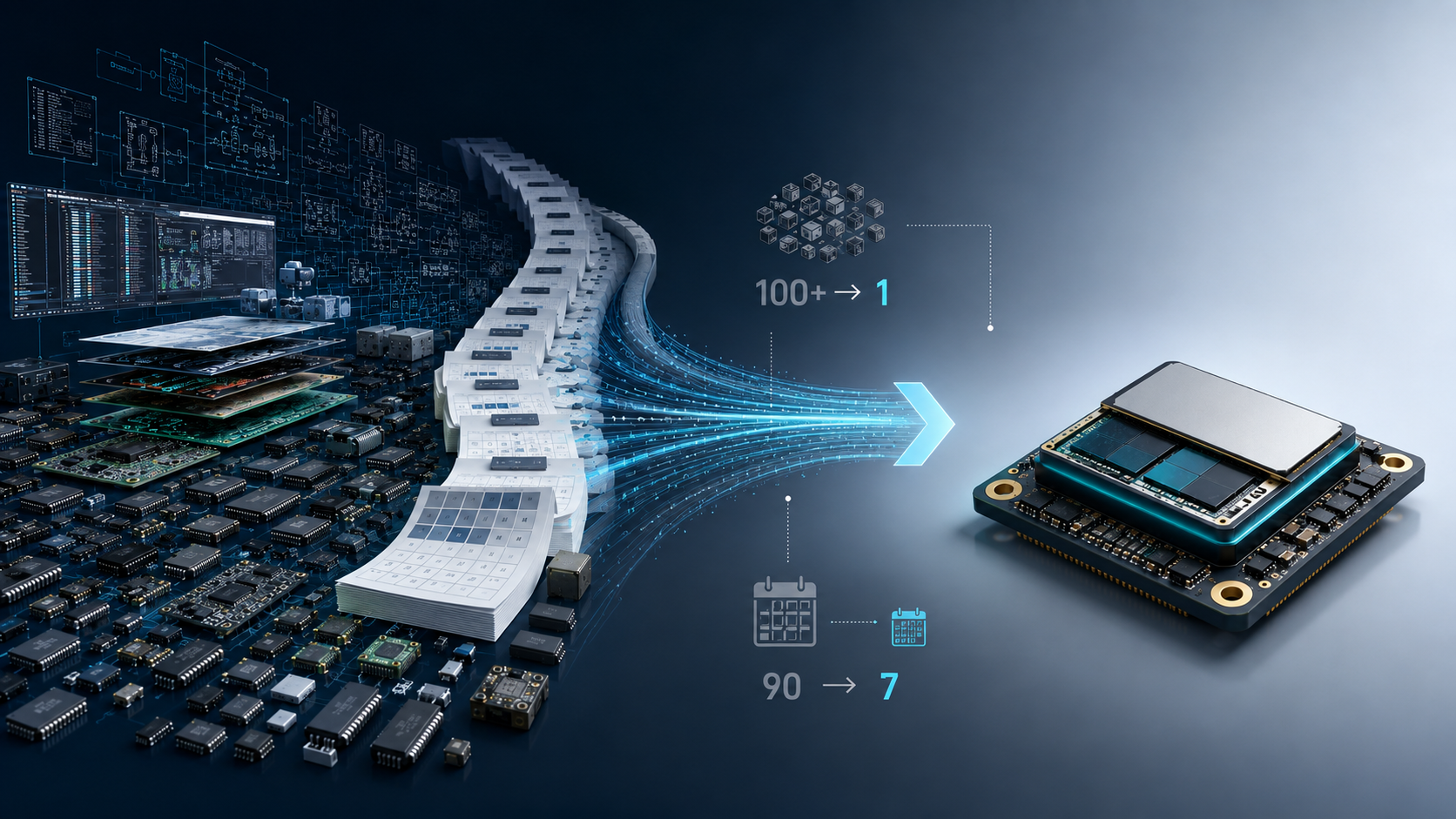
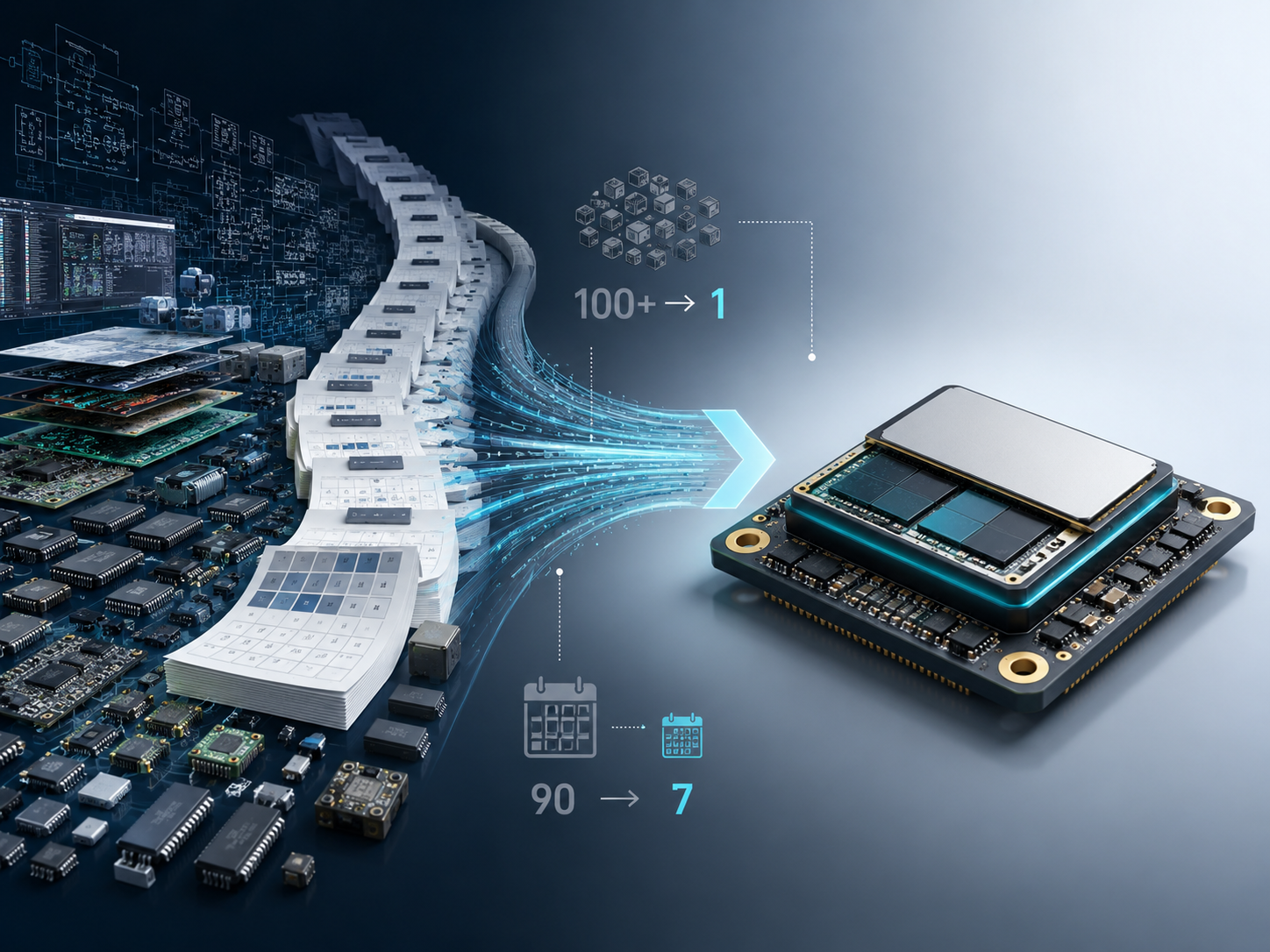
In Nar Series products, the processor, memory, power management, clock source and communication units come together inside a single BGA package. In other words, the entire chain described above has already been designed once, verified and made production ready before the product reaches you.
In practice, that means:
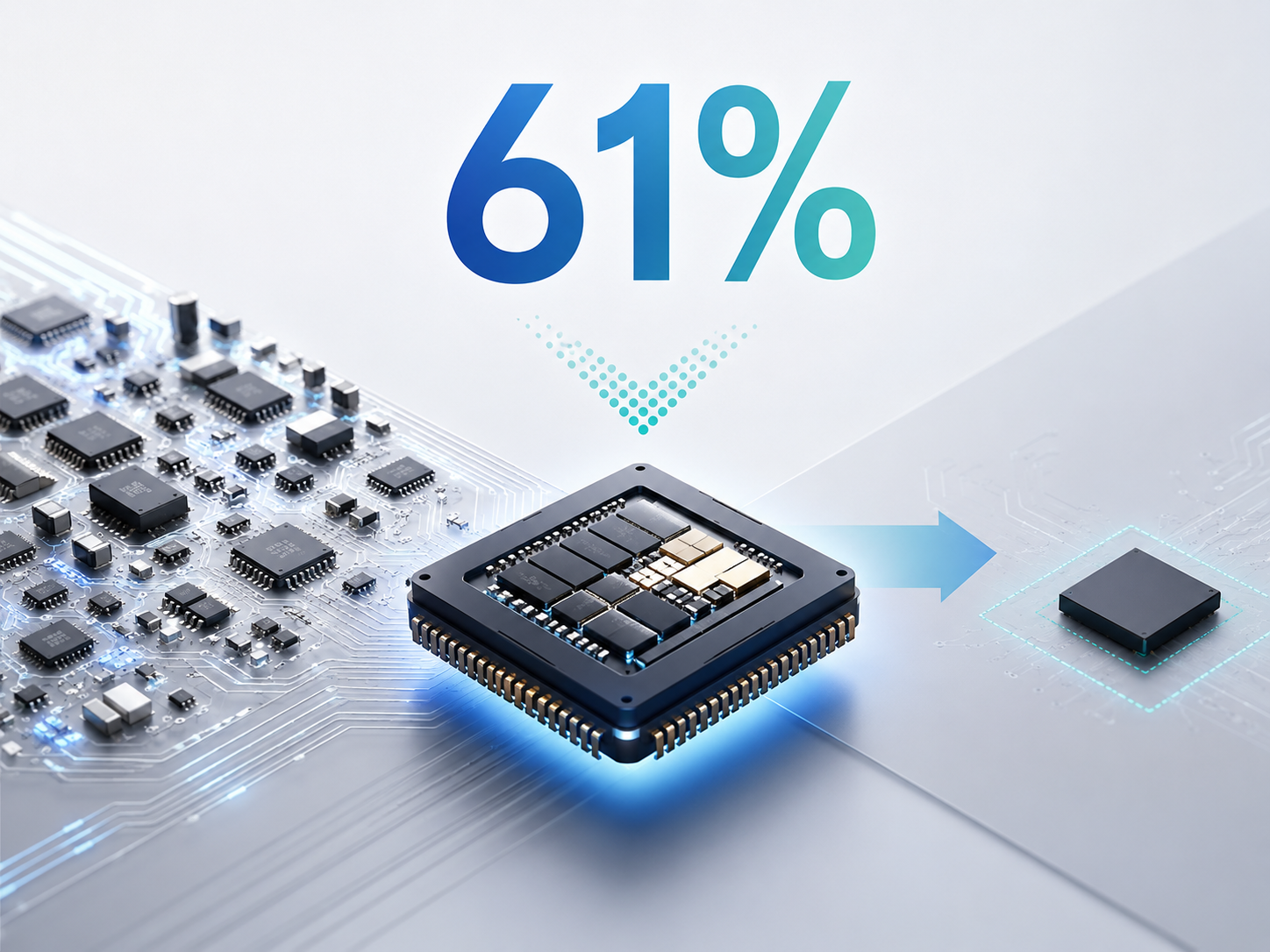
- A single SiP instead of more than 100 components. The processor subsystem collapses into one symbol in your schematic.
- Up to 61% board area savings. The board shrinks, the layer count drops, assembly gets simpler.
- A single part number. You track one line item in your supply chain instead of dozens.
- We take on the risk. Signal integrity, power sequencing, thermal management and DDR routing stay on our side.
What remains for you is drawing your carrier board and writing your application. How long that takes is now set by the complexity of your own product, not by the risks of the processor subsystem. The customer does not redesign that subsystem; they build their own application on top of a core that already works.
What we bring down to days, and what we do not
It is worth drawing the boundary of this promise clearly. What comes down to days is the shared layer that repeats in every project: designing, verifying and production-proving the processor, memory, power management and communication core. Because that layer arrives ready with Nar Series, it leaves your schedule entirely.
What does not come down to days is your product itself. Your sensor selection, your interface circuits, your mechanical design, your field testing and your certification process all run on their own schedules.
The software side comes ready too
Faster hardware does not help much on its own if the software side is left empty. That is why we ship Nar Series products with an open source software ecosystem. On the Linux side there is a ready build based on the Yocto Project, NarRTOS covers real time requirements, and the ESP-IDF ecosystem is in place on ESP32 based products.
Datasheets, reference schematics and example applications belong to the same package. We do not want an engineer to lose weeks on the question of how to bring the board up after opening the box.
Four segments, one approach
We carried the same methodology into four separate products for four different application areas:
| Product | Segment | Typical use |
|---|---|---|
| NAR-3358 | Industrial automation | PLC/HMI, energy management, metering systems, kiosk |
| NAR-ESP32S3R16-32 | IoT and wearables | Sensor devices, smart home, tracking devices |
| NAR-32MP2x | Edge AI and vision | Smart cameras, quality inspection, medical imaging |
| NAR-9151-E1 | Cellular connectivity | Asset and vehicle tracking, smart metering, remote monitoring, agricultural IoT |
Take NAR-3358 as an example. A TI Sitara AM335x processor, DDR3L memory, 32 GB eMMC, TPS65217C based power management and a MEMS oscillator all come together in a single BGA package. A team designing an industrial control board places that entire block as one component instead of rebuilding it on their own board.
Why do we call this Generative Hardware?
In the software world, nobody writes a database engine from scratch. You start from proven building blocks and add your own layers on top. On the hardware side, the same basic blocks still get redrawn in every project.
Generative Hardware is the name we give to our effort to reverse that habit. We make the repeating layer of a product ready and verified, and teams build their own layer on top of it. The result is a gain you can measure on the calendar.
Next step
If you would rather start your next project from a working core than redesign the processor subsystem, let us talk. We will work out together which Nar Series product fits your application, and share the datasheet and reference design with you.
Contact: [email protected]
Featured Posts
Months Turn Into Days | Corezzle Electronics
2026-08-10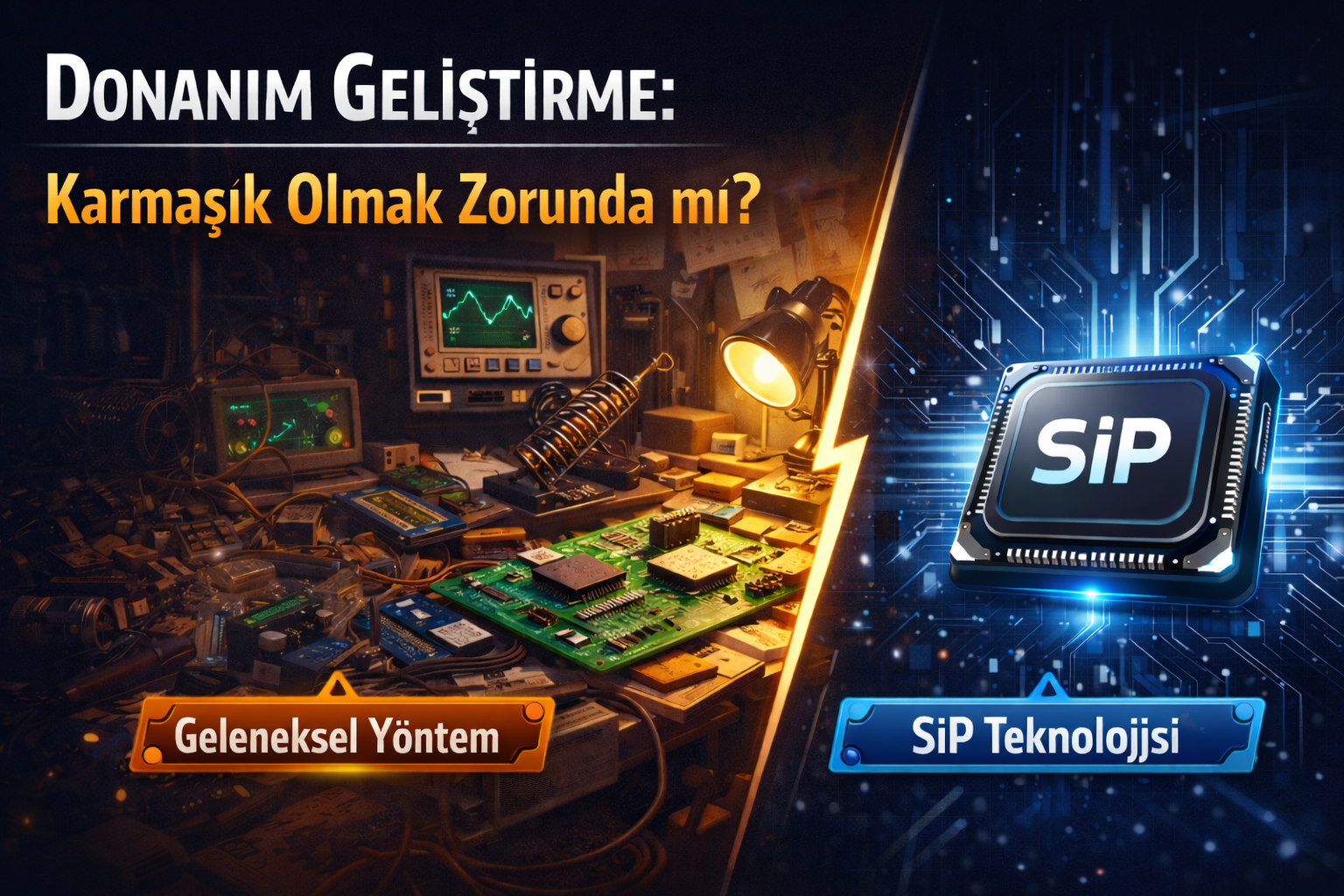
Does Hardware Development Really Have to Be This Complex?
2026-04-08Recently Added Posts
One Package, 61% Smaller | Corezzle Electronics
2026-08-10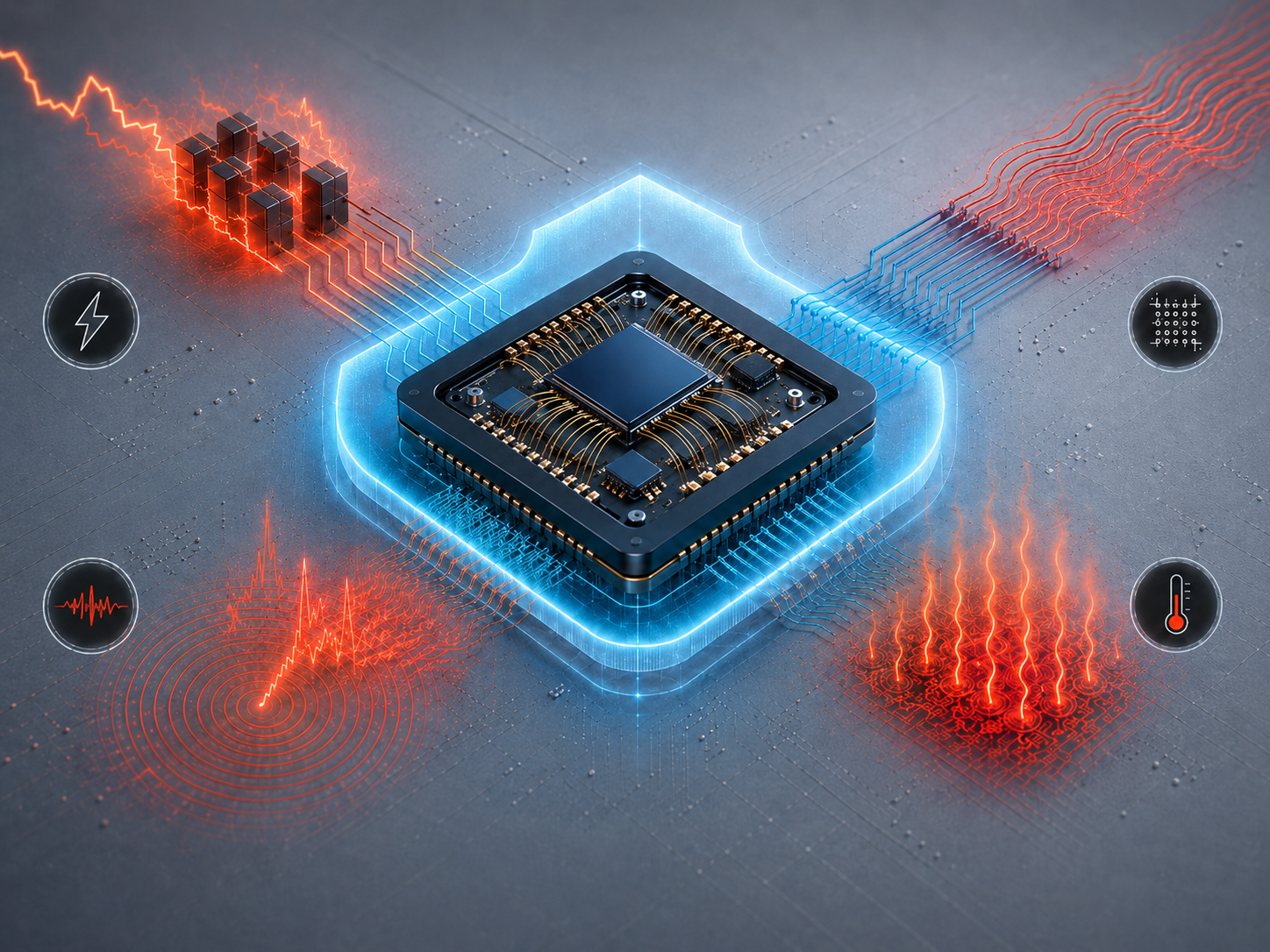
We Take On the Risk | Corezzle Electronics
2026-08-10